Welcome to Linda Aronson's website...
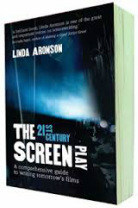
Linda is a multi award winning scriptwriter, novelist and playwright who also consults on film and TV scripts, teaches scriptwriting for TV and film and writes for TV and more recently, VR. She is the only screenwriting consultant who, as well as advising on conventional structure Hollywood style, also provides practical guidelines for writing complex nonlinear film and TV series (and some cross media, transmedia and games) using flashback, time jumps and multiple fractured storylines. Her most recent workshops are how to use nonlinear story arcs in TV series to create binge viewing. She is one of the busiest gurus on the international circuit and her books Screenwriting Updated and The 21st Century Screenplay are required reading at film schools all over the world.
Interested in writing nonlinear and complex multiple storyline film and TV?
If your script doesn't fit the historical Hollywood linear chronological one hero model or if you're just interested in learning more about what TV and Film writing are going to be about in future, start by reading the extensive free information on this site (including free podcasts and videos) and by subscribing to Linda's free newsletter (which also contains information about upcoming workshops, masterclasses and mentorship places - scroll down to subscribe).
Workshops and Masterclasses
Covid restrictions have prevented Linda from traveling, but she is am giving workshops and masterclasses online. Subscribe to the newsletter for more details. Linda has also created a new online teaching platform, Linda Aronson's Secrets of the Writers Room. Eventually, this will offer courses on nonlinear and parallel narrative structure for film and TV. Linda has already created a TV writing course, which she will offer a couple of times a year. You can access a free online course on Creativity under Pressure on this teaching platform. .
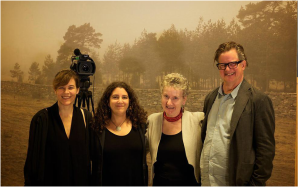 Keynote Speakers (l to r)
Katerina Cizek (MIT), Sarah Wolozin (MIT), Linda Aronson, Alex McDowell (USC)
Keynote Speakers (l to r)
Katerina Cizek (MIT), Sarah Wolozin (MIT), Linda Aronson, Alex McDowell (USC)
Games writers!
Linda's keynote talk at the Gotland Symposium on Games + Film is now available
View the video!
Games Writers - New Video on how to Use Parallel Narrative and nonlinear narrative in games
Linda's keynote talk at the Gotland Symposium on Games + Film is now available
View the video!
Games Writers - New Video on how to Use Parallel Narrative and nonlinear narrative in games
NEW FREE PODCAST by Linda for the International Screenwriters' Association Los Angeles
Here's what they said...
Want a career in ten years? Flashback, nonlinear, ensemble and multi-plot structures are now mainstream in film and TV. You'll need them. In this revolutionary course, award-winning writer Linda Aronson cracks the code of complex films like Pulp Fiction, 21 Grams and Memento, showing they aren't aberrations or 'devices' but structures in themselves, falling into six families. She explains that they work by multiplying, fracturing and reconstituting the one-hero chronological model according to patterns, patterns so predictable that writers can use them as templates for film, new generation TV series, games and cross media. Eureka!
* * * * *
Here's what they said...
Want a career in ten years? Flashback, nonlinear, ensemble and multi-plot structures are now mainstream in film and TV. You'll need them. In this revolutionary course, award-winning writer Linda Aronson cracks the code of complex films like Pulp Fiction, 21 Grams and Memento, showing they aren't aberrations or 'devices' but structures in themselves, falling into six families. She explains that they work by multiplying, fracturing and reconstituting the one-hero chronological model according to patterns, patterns so predictable that writers can use them as templates for film, new generation TV series, games and cross media. Eureka!
* * * * *
What people are saying about Linda Aronson....
'Linda Aronson is one of the great and important voices on screenwriting.’ Linda Seger, author of Making a Good Script Great
'At last you will understand "Pulp Fiction! All the vague confusing things that teachers and studio executives say about flashback, turning points and multiple protagonists are whipped into coherent shape, in a comprehensive, precise and extremely practical theory.' Christopher Vogler, Author of The Writers' Journey
Read more endorsements of Linda Aronson's work
'Linda Aronson is one of the great and important voices on screenwriting.’ Linda Seger, author of Making a Good Script Great
'At last you will understand "Pulp Fiction! All the vague confusing things that teachers and studio executives say about flashback, turning points and multiple protagonists are whipped into coherent shape, in a comprehensive, precise and extremely practical theory.' Christopher Vogler, Author of The Writers' Journey
Read more endorsements of Linda Aronson's work

Want to write a TV series? Here's a video about it
|
Linda speaks on The Rise of Parallel Narrative
Is the Three Act Structure dead?
Not at all.
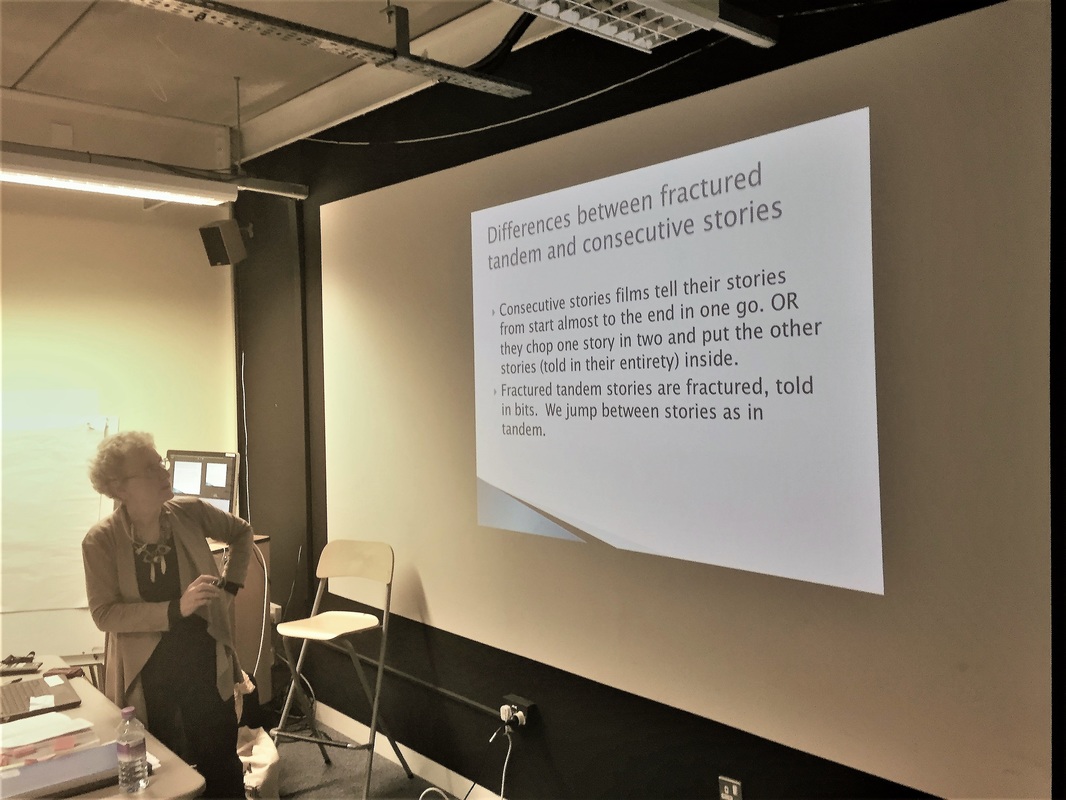
It's great for one-hero, fast-set-up chronological stories. But scriptwriters don't have to stick solely to that kind of story (and actually we never have). The great news is that there are many structural models out there working to clear patterns, so you can plan them. Flashback, flash forward, multiple plots, nonlinear and ensemble cast films have always existed, but the guidelines I've isolated mean that venturing beyond the conventional model is no longer a step into the unknown. Yes, it's perilous, but we have a map. Instead of feeling safe only with one protagonist we can use many. We can use multiple plots, either running side by side as in TV series, or in fractured form, as in Babel . We can use a whole range of flashback and time jump structures. Even films as apparently aberrant as Pulp Fiction or 21 Grams turn out to be written to patterns. 21st Century Screenplay gives you the tools and structural elements necessary to construct your own non-linear story. Don't let anyone tell you you can't write outside the three act structure - you can, people do and it is just as valid as writing within it. See Video of Linda at The London Screenwriters' Festival Use this Site as a Resource
Use this site as a resource This website can only be the start of your investigations into parallel narrative. Navigate the site to get your head around the principles of parallel narrative (plus my take on conventional narrative). You'll find articles, advice, tricks of the writing trade and a blog in which I analyze parallel narrative films, or comment on craft issues generally. I hope you find it useful and I look forward to seeing all of the terrific films that flashback, multiple plots, ensemble casts and non-linear story lines can help to you to write. There are a number of videos of me on YouTube discussing parallel narrative
Note from Linda... Hi everyone. I've started a newsletter to replace the blog. You can subscribe below. Once you've done that you'll get the next newsletter. You'll also be able to view previous issues. Just be aware that the newsletter program I'm using has anti-spam double opt-in system to protect us both and I am required to do it. So you will be asked to confirm your subscription. Terrific idea in my view, if a bit tedious. We all hate spam!
Subscribe to Linda Aronson's Craft Skills Newsletter
|